
How Dental Implants Integrate with Your Natural Bone

Dental implants are titanium posts that serve as artificial tooth roots, providing a permanent foundation for replacement teeth. Through a biological process called osseointegration, the implant fuses directly with the jawbone, creating a stable and durable bond that mimics the function of a natural tooth root.

The Science of Osseointegration

The reason dental implants are the “gold standard” for tooth replacement is their ability to become part of your body. Titanium is a biocompatible material, meaning the bone cells in your jaw actually grow around the implant threads. This fusion doesn’t just hold the implant in place; it also stimulates the bone. Without a root or implant, the jawbone can begin to shrink over time, but an implant keeps the bone active and healthy.

A Permanent Solution

Unlike bridges, which rely on the strength of neighboring teeth, or dentures, which can slip, implants are self-supporting.

  • Natural Feel: You can eat and speak exactly as you did with natural teeth.
  • Bone Preservation: Implants prevent the facial collapse associated with bone loss.
  • High Success Rate: With proper hygiene, implants are designed to last for decades.

Invest in a permanent smile. Indiana Emergency Dental uses 3D diagnostics to plan precise implant placement for the best long-term results. Schedule your implant consultation in Indianapolis today.

Can I Get Emergency Dental Implants?

Dental implants are the best way to replace your natural teeth, so it’s no surprise that patients want to get started as quickly as possible. If you’re interested in how soon dental implants can be placed, we’ll look at the details below.

Emergency Dental Implants

In some cases, you can get emergency dental implants. So, if you suddenly lose a tooth, either due to extraction or trauma, a dentist in Indianapolis, IN may be able to place the metal post into the jawbone and then attach a temporary crown until you can get your permanent artificial tooth. As a general rule, implants are recommended as soon as possible after tooth loss to avoid unnecessary bone deterioration.

What to Know About Dental Implants

Dental implants are treated on a case-by-case basis, meaning that some people may have to wait before they’re eligible for the procedure. For example, if your mouth has sustained serious injuries, your gums and jaw may not be healthy enough to sustain the procedure. In addition, the healing process for a dental implant in Indianapolis, IN can take several weeks to several months, so while it’s possible to begin the process the same day, you’ll still need follow-up care.

Emergency Care in Indianapolis, IN

At Indiana Emergency Dental, we offer emergency services through our 24/7 call center to patients who can’t afford to wait for care. We also look out for our patient’s long-term needs, ensuring that our team doesn’t rush treatment or services nor hold back at critical moments. Whether you lose your tooth at hockey practice or after a severe infection, we find treatments to restore your mouth and preserve your oral health.

What to Know About Osseointegration During Your Dental Implant

Osseointegration is a scientific term, one that you might not understand if you’re deciding whether or not to get dental implants in Indianapolis, IN. Here, we’ll look at what exactly it is and why it matters for implants.

How Osseointegration Works

Osseointegration refers to the process of fusing the metal implant to the bone. The process takes a few steps:

  • When you get an implant, the dentist has to cut into the gumline to place a small post.
  • Once the dentist sets the post next to the bone, the body’s response is to start the healing process.
  • As the patient heals, the bone and the metal fuse together.

This is the very foundation of the implant, it’s what gives the abutment and artificial tooth the roots that it needs to stay strong against impact (whether it’s from a fall or a particularly hard praline).

Does Osseointegration Always Take?

No, for select patients, this process doesn’t always take. A good dentist in Indianapolis, IN can cut back on potential failure through better assessments and evaluations, but sometimes, there’s no way to predict when this process will fail. Thankfully, the odds of rejection may be as low as 5%, though again, a reputable dentist may be able to cut back on the risk even further.

If you have questions about dental implants, including how long it takes for the healing process to occur, whether or not you’re eligible for the procedure, and what you can expect from your artificial tooth once it’s fitted, contact the team at Indiana Emergency Dental today. Our staff is here to not only answer your general questions but to offer you additional insights into how the treatment will personally impact you!

A dentist wearing gloves and a mask shows a dental model to a patient sitting in a dental chair, who is looking at it and smiling.

Which Is Better, a Bridge or an Implant?

Losing a tooth can be frustrating, and it can make it hard to speak clearly or eat the way you want. That said, choosing the right replacement doesn’t have to be difficult. The two most common options are dental bridges and implants. Both can restore your smile, but they each have their upsides and downsides. At Indiana Emergency Dental, we want to talk to you more about getting bridges and implants in Indianapolis and Bloomington, Indiana.

What Is a Bridge vs. an Implant?

Bridges and implants are slightly different (and sometimes can both be used at the same time).

  • A bridge uses the teeth on either side of the gap for support and “bridges” the gap between two teeth with a prosthetic.
  • A dental implant replaces the entire tooth—root and all—using a small titanium post that fuses with your jawbone. Two or more dental implants can be used to support a bridge, in some cases.

Which Option Is Best?

The answer is: It depends.

  • Bridges are great for quick results. They’re non-surgical and can usually be completed in two visits. The downside is that you have to put crowns on the teeth beside the gap, which does cause some damage.
  • Implants take a little longer to complete, but they are more durable and have a more natural feel. They replace your tooth’s root completely, which can help protect the jawbone.

Learn More About Bridges and Implants in Bloomington and Indianapolis, IN

Ready to replace your missing tooth? Contact us to schedule an appointment at Indiana Emergency Dental in Bloomington or Indianapolis, Indiana, at 1-463-276-0541. We are here to walk you through the options, so you understand how each works and what might be best for you.

A young person in a denim shirt stands against a white background, looking up with a thoughtful expression, one hand on their chin and the other arm crossed.

Who Can and Can’t Get Implants?

Who Can/Can’t Get Implants?

Interested in dental implants in Indianapolis, IN, but not sure if you’ll qualify? The good news is that many people benefit from implants, and there are various types that could be the right fit for you. Here is some information about dental implants and who they work for best.

Who Can Get Dental Implants?

Most healthy adults are able to get dental implants, but there are some ideal candidates. The best candidates:

  • Have healthy gums
  • Can commit to keeping up good oral hygiene
  • Have strong bone in the region, which is necessary to support a dental implant

If you’ve been told in the past that you don’t qualify based on bone density or your dental health, consider talking to our team about getting an implant. With new technologies like bone grafting or mini implants, we may have new options you had not considered before.

Who Is Unlikely To Be a Candidate for Dental Implants?

Some individuals may not be ideal candidates for dental implants. They may include those who:

  • Smoke tobacco/cigarettes
  • Have uncontrolled conditions that affect the gums or teeth, like diabetes
  • Have advanced gum disease
  • Have autoimmune disorders that may reject an implant more aggressively than in those without them

If you’re not a candidate for a dental implant, remember that there are alternatives. Our team at Indiana Emergency Dental would be happy to talk to you about an implant or an alternative, such as a dental bridge or dentures, during your consultation.

Schedule Your Consultation for Implants in Indianapolis, IN

Ready to learn more about getting an implant? Call us today at 1-463-276-0541, and we will get you on our schedule.

3D render of two white teeth and a dental implant model displayed on blue geometric platforms against a blue background.

How Long Do Dental Implants Last?

Dental implants are a highly effective option for those considering tooth replacement. You get a natural-looking tooth and avoid the issues that can come with dentures or bridges. One common question our dental implant dentist in Indianapolis, IN, receives is, ‘How long do the implants last?”

How Long Can You Expect Dental Implants to Last?

It’s a fair question, but not an easy one to answer. Dental implants, by design, are intended to last up to 20 years. For some, they will last their lifetime.

We typically use a titanium post for our implants. The implant fuses with your jawbone to create a strong foundation. Once the post is secure, we add on a crown that can handle 15 years of wear and tear.

That’s all good news. There are factors that can change that dynamic, though.

What Factors Can Impact the Longevity of Dental Implants?

At the top of the list is your oral hygiene. The implants rely on your jawbone and gum tissue remaining healthy. That means you must brush, floss, and get regular dental checkups to maintain that health.

Gum disease not only erodes the soft tissue of the gums but also weakens the jawbone. That weakening can mean your implants lose their stability and come out. Other factors that matter for dental implant longevity include:

  • Lifestyle—Eating right and controlling conditions like grinding teeth will help your jaw better support the implants.
  • Underlying Health Problems—Certain chronic illnesses can impact your oral health and, subsequently, how long the dental implants last. Diabetes and osteoporosis are the most common issues.

Also, the quality of the implant and its placement are potential factors.

Protecting Your Dental Implants 

The best way to protect your dental implants is to maintain good oral hygiene. Our dental implant dentist in Indianapolis, IN, will educate you on what it takes to ensure your implants last a lifetime. Call us today at Indiana Emergency Dentalto make an appointment if you have questions about dental implants.

Person in blue clothing and purple gloves holding dental models: one shows a dental implant and teeth, the other shows a jaw with missing teeth.

Dental Bridge vs. Implant: Which Tooth Replacement is Right for You?

A dental implant and a bridge are two reliable ways to fill the space a missing tooth leaves. Both do the same thing but use a different approach. Our staff for restorative dentistry in Indianapolis, IN, will work with you to decide the best option for your needs.

What Is a Dental Implant?

dental implant is a titanium post that is inserted into the jawbone to anchor a prosthetic tooth. Once implanted, the post integrates with the bone and fuses, acting like a normal tooth root, giving the restoration a natural look and feel.

What Is a Dental Bridge?

dental bridge is a restoration that bridges the gap between teeth when one or more teeth are missing. The bridge is the prosthetic teeth that fill this space, making your smile whole again.

There are two forms of attachments for a bridge: a dental implant or abutment teeth. Abutment teeth are the two teeth on either side of the gap. The restorative dentist in Indianapolis, IN, modifies these teeth and fits them with crowns that serve as anchors for the bridge.

Dental Bridge vs. Implant: Which Tooth Replacement is Right for You?

Either choice is practical. In some cases, you have both. Implants can serve as anchors for a dental bridge. Picking the right opportunity depends on several factors:

  • Budget— Dental implants can be more expensive than a bridge with abutment teeth.
  • Jaw health—For an implant to succeed, you must have enough healthy bone in your jaw to support it. If not, it might be possible to graft bone to secure the implant.
  • Timeline—Dental bridges are faster and take fewer trips to the office.

Implants can last longer than a dental bridge, so even if they are more of an investment, they might be a better prospect for a qualified candidate.

If you have one or more missing teeth, make an appointment with our restorative dentist in Indianapolis, IN, today to discuss your best choices.
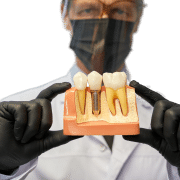
A person wearing a black mask and gloves holds a dental model showing three teeth, one with a dental implant, against a plain green background.

What Is Peri-Implantitis and How to Prevent It

Dental implants are the industry standard for tooth replacement for a reason. They have a very high success rate and are one of the best ways to restore a smile. Like any medical procedure, though, there are potential complications, such as peri-implantitis. When you get a dental implant in Indianapolis, IN, the staff will review the risk factors with you and explain how to prevent peri-implantitis.

What Is Peri-Implantitis?

Peri-implantitis is the medical term for an inflammatory response around a dental implant that causes bone loss. Inflammatory responses are how the body responds to infection or tissue damage. It is what causes wounds to heal and swelling when you sprain your ankle.

In many ways, peri-implantitis is similar to traditional gum disease, but it occurs around a dental implant instead of a natural tooth. When this inflammatory response occurs around a dental implant, it typically means that plaque is building up there. Plaque is a byproduct of bacteria, which could indicate a potential infection.

Symptoms of Peri-Implantitis

Symptoms of peri-implantitis include:

  • Gum redness and bleeding
  • Swelling around the implant
  • Gum recession
  • Pain around the implant
  • The implant falling out

You should contact your dentist in Indianapolis, IN, if you have any of these symptoms with a dental implant.

Preventing Peri-Implantitis

The staff at Indiana Emergency Dental will go over how to care for your new dental implant. The key to protecting it is good oral hygiene and regular dental check-ups. The dentist will recommend that you brush at least twice a day and floss once a day. They may also suggest using a water flosser to clean debris around the implant.

In addition, you’ll want to manage any underlying medical problems that might affect the health of the implant, such as diabetes or osteoporosis. They can impact healing.

If you have questions about dental implants, call our office today to schedule an appointment with one of our dentists in Indianapolis, IN, and learn more.

A healthcare professional wearing gloves examines the inside of a womans mouth using a tongue depressor and light.

What You Need to Know about All-on-4 Dental Implants

Are you thinking about getting dental implants in Indianapolis, IN? Then you probably want to know your options…right? Have you ever heard of all-on-4 dental implants? They are an affordable alternative. Here is what you need to know about them.

All-on-4 Dental Implants Explained

All-on-4 dental implants are an affordable alternative to a whole month of implants. This option is excellent for people missing all or most of their teeth. A dentist in Indianapolis, IN, can perform the implant procedure.

All-on-4 implants are stronger and more stable than traditional dentures. They differ from a full mouth of implants because only four implants are used versus one for each tooth.

How Many Teeth Do You Get with All-on-4 Dental Implants?

Typically, a single arch consisting of 14 teeth is used. However, only four dental implants are needed to hold that arch in place. Thus, the name all-on-4s.

Do All-on-4 Dental Implants Last Forever?

No, all-on-4 dental implants don’t last forever. They typically last between 15-20 years. But that’s just for the artificial teeth portion of the implant. The titanium post/screw part of the implant that is placed into your jawbone will usually last forever.

Can You Eat Normally with All-on-4 Dental Implants?

Yes, there are no diet restrictions with all-on-4 dental implants. You can eat normally. However, right after your dental implant procedure, you must wait about three to six months before you can eat certain foods. Your dentist will make recommendations based on your progress.

Do All-on-4 Dental Implants Feel Like Your Natural Teeth?

Yes, dental implants look and feel like your natural teeth!

Looking for an Exceptional Dentist in Indianapolis, IN?

If you are interested in getting all-on-4s, you are going to need a dentist. Please Contact Indiana Emergency Dental today to schedule a dental implant consultation. We’d love to show you how affordable implants can be!

A woman sitting in a dental chair smiles and gives a thumbs up, wearing a dental bib in a clinic setting.

3 Reasons to Consider Implants to Replace a Lost Permanent Tooth

A missing tooth can leave a big gap that can impact your day-to-day life. While there are many things that you can do to fill that hole, one of the best options is to install a dental implant. At Indiana Emergency Dental, we install dental implants to help patients regain their smile and feel better about their personal appearance.

As yourdentist in Indianapolis, IN, we offer streamlined, effective implant installation procedures to help make your smile whole again. Below are three reasons to consider implants to replace your missing tooth.

1. Implants act just like real teeth and are maintained like real teeth, too.

Implants are drilled into the jaw and inserted into the bone. This mimics the way real teeth have roots that sit inside the jaw to hold the tooth in place. Because implants function like real teeth, this means they’re maintained just like your real teeth.

To take care of your implant, you’ll brush it twice daily, use dental tools to remove food bits from the corners around the tooth, and you’ll see the dentist twice per year to get your implant (and the rest of your teeth) examined and cleaned.

2. Implants look just like real teeth.

No one will know you have an implant once it’s installed. Your implant will look just like your real teeth. It will be shaped like other teeth, and it will even be the color of your other teeth, so it will fit right in.

3. Implants restore your smile. 

A gap can leave you feeling self-conscious about the way you look. When you install an implant, you can restore your smile and feel good about the way your smile looks.

Have questions aboutimplants in Indianapolis, IN? Think you’re ready for implant installation? Talk to the dental professionals at Indiana Emergency Dental.